There is a quiet revolution happening on the walls of Europe’s finest interiors. Not a revolution of colour or pattern, but of texture, depth and material honesty. Across Switzerland and beyond, architects and discerning homeowners are turning away from smooth painted surfaces and rediscovering something far more compelling: the ancient craft of decorative plaster finishes, applied by hand, one layer at a time.
Venetian plaster, tadelakt, lime render, marmorino, microcement — these are not new inventions. Some of them are thousands of years old. What is new is the intensity of the demand for them in 2026, and the growing recognition that these surfaces represent something no industrial process can replicate: genuine craftsmanship, unique to each application, alive with light and texture in a way that a standard painted wall simply cannot be.

Venetian Plaster: The Finish That Looks Like Liquid Marble
Venetian plaster, known in Italian as stucco veneziano, is a lime-based decorative finish that has been used in architecture since antiquity and refined into an art form during the Renaissance. Applied in multiple thin layers with a steel trowel and burnished to a high sheen, the result is a surface that resembles polished marble — but with a warmth and depth that no stone slab can match.
The finish is achieved through a combination of skilled application and careful timing. Each layer must be applied at precisely the right moment, neither too wet nor too dry, before being burnished with circular strokes to compress and polish the surface. The final result has a luminous quality that changes throughout the day as natural light moves across the room.
For interior renovation projects in Switzerland, Venetian plaster is particularly well suited to reception rooms, hallways and bathrooms where an impression of timeless elegance is the goal. It pairs beautifully with natural stone, solid wood and the muted colour palettes favoured by the quiet luxury aesthetic.
Tadelakt: The Ancient Moroccan Plaster Built for Water
Tadelakt is a waterproof lime plaster originating from Morocco, traditionally used in hammams and riads. Its name comes from the Arabic word meaning “to rub” — a reference to the polishing process that gives the surface its characteristic silky sheen and water-resistant properties.
The application process is even more demanding than Venetian plaster. The lime is applied in thick, even coats, then polished with a smooth stone and treated with black soap derived from olive oil. This chemical reaction between the soap and the lime creates a surface that is not only beautiful but genuinely waterproof and resistant to mould — making it one of the most practical and elegant solutions available for high-end bathroom renovation.
The appeal of tadelakt for discerning clients is obvious: it is a material with centuries of history, entirely natural in its composition, impossible to fake industrially, and extraordinarily sensory in its finished form. Running a hand across a properly executed tadelakt wall is an experience that no ceramic tile or acrylic coating can replicate.
Lime Render and Marmorino: Versatility at the Highest Level
Beyond Venetian plaster and tadelakt, the family of decorative lime finishes offers a wide range of possibilities for the interior renovation project that demands something beyond the ordinary.
Marmorino is a finer-grained version of Venetian plaster, ground from marble dust and applied in thinner layers. The result is more delicate, with a softer sheen and a slightly more textured surface that catches light differently from every angle. It is particularly popular for bedroom walls and study spaces where a contemplative, refined atmosphere is sought.
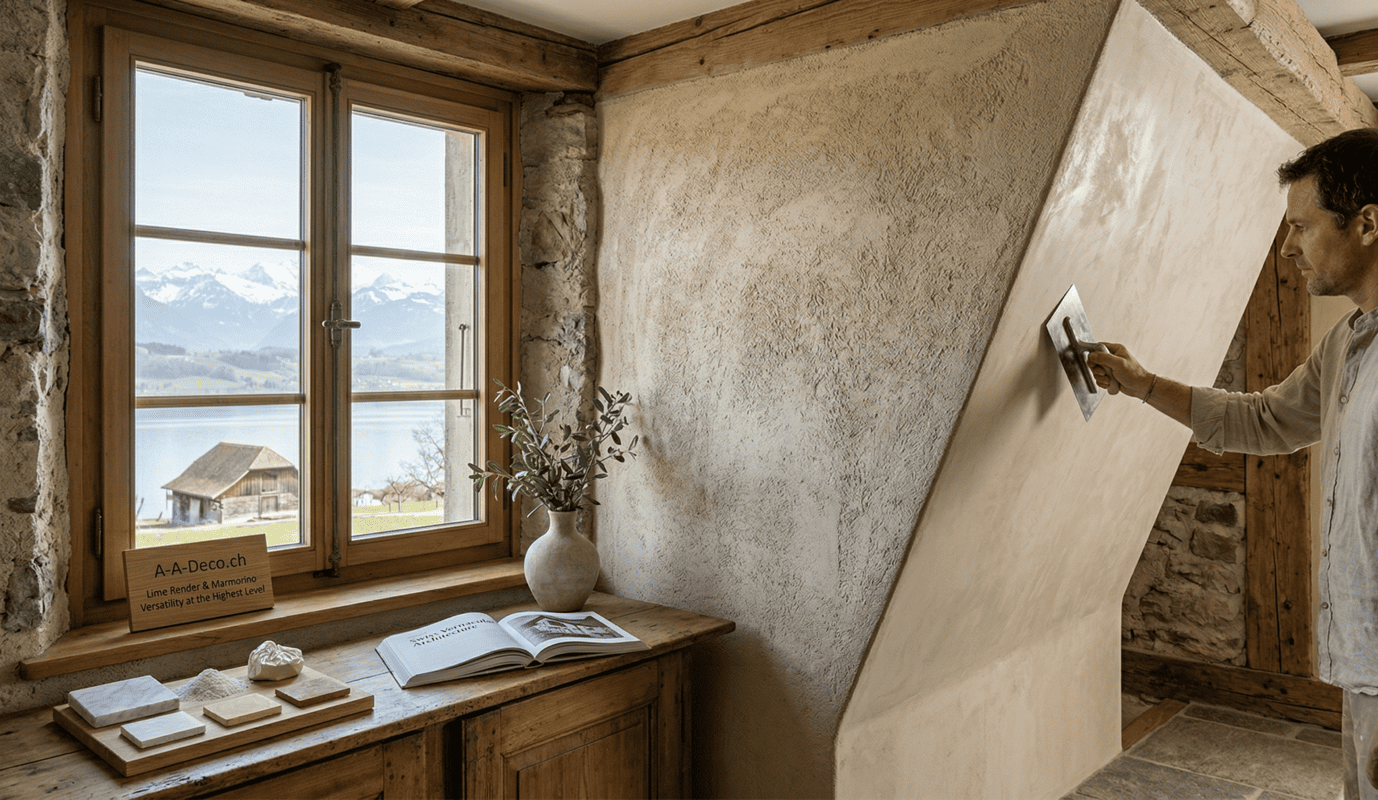
Natural lime render, applied with a float rather than burnished to a polish, creates a subtly textured surface that breathes with the building. For the renovation of older Swiss properties — farmhouses, historic townhouses, period apartments — a lime render is not only aesthetically appropriate but technically essential. Old buildings need walls that can manage moisture movement. Lime does this naturally, allowing the building to breathe and preventing the trapped moisture that causes so many problems in properties renovated with modern impermeable coatings.
The New Generation of Microcement: Beyond the Béton Ciré
Microcement — sometimes referred to as béton ciré in French — has been a fixture of high-end interior design for over a decade. But the product has evolved considerably. The newest generation of microcement formulations offers improved flexibility, reduced cracking risk, and a wider range of textures and finishes than earlier versions.
More importantly, the application expertise required to achieve a truly flawless microcement surface has become a genuine differentiator between professional renovation companies. A well-applied microcement floor or wall surface is seamless, warm and incredibly versatile. An inexperienced application reveals every bubble, every join, every area where the thickness was inconsistent. The difference between the two outcomes is entirely about the skill of the person holding the trowel.
Why These Finishes Demand a Specialist
This is the point that matters most for any homeowner or architect considering decorative plaster finishes for a home renovation project: these are not techniques that a generalist can learn on the job.
Each of these finishes requires specific training, the right tools, an understanding of how different substrates behave, and a level of manual dexterity that only comes with practice. The preparation of the underlying surface is as important as the finish itself — any movement, crack or humidity in the substrate will eventually telegraph through even the most beautifully applied Venetian plaster.
A professional painting company with genuine expertise in decorative plaster finishes will always begin with a thorough assessment of the surfaces to be treated. They will discuss the specific properties of each finish with the client and the architect, recommend the right product for the room’s function and exposure, and apply it with the care and patience the material demands.
This is what separates a decorative plaster finish that remains beautiful for twenty years from one that begins to show problems within the first season.
An Investment That Holds Its Value
For clients investing in a high-end interior renovation in Switzerland, decorative plaster finishes represent one of the most durable and value-retaining choices available. Unlike painted surfaces that need refreshing every few years, a properly applied Venetian plaster or tadelakt wall improves with age. The surface develops a patina that adds character rather than signalling wear.
In an era where the luxury market increasingly prizes authenticity, uniqueness and the evidence of genuine human skill, a wall finished by hand — in a technique with centuries of history behind it — communicates exactly the values that the most thoughtful interiors aspire to.
Interested in decorative plaster finishes for your renovation project in Switzerland? Contact AA Deco to discuss your requirements with our specialist team and discover how we can transform your walls into something truly exceptional.